
In Leonardo´s Footsteps
Learn to see beyond the surface

The path of a Visionary
What does it mean to see?
APRIL 21–28, 2027
Vinci • Florence • Milan, Italy
Long before Leonardo da Vinci became the painter of The Last Supper and The Mona Lisa, he was a curious child wandering the hills around Vinci. He watched the movement of water, the flight of birds, the anatomy of plants, the play of light across stone, and the endless patterns woven through nature. His genius did not begin with painting. It began with attention.
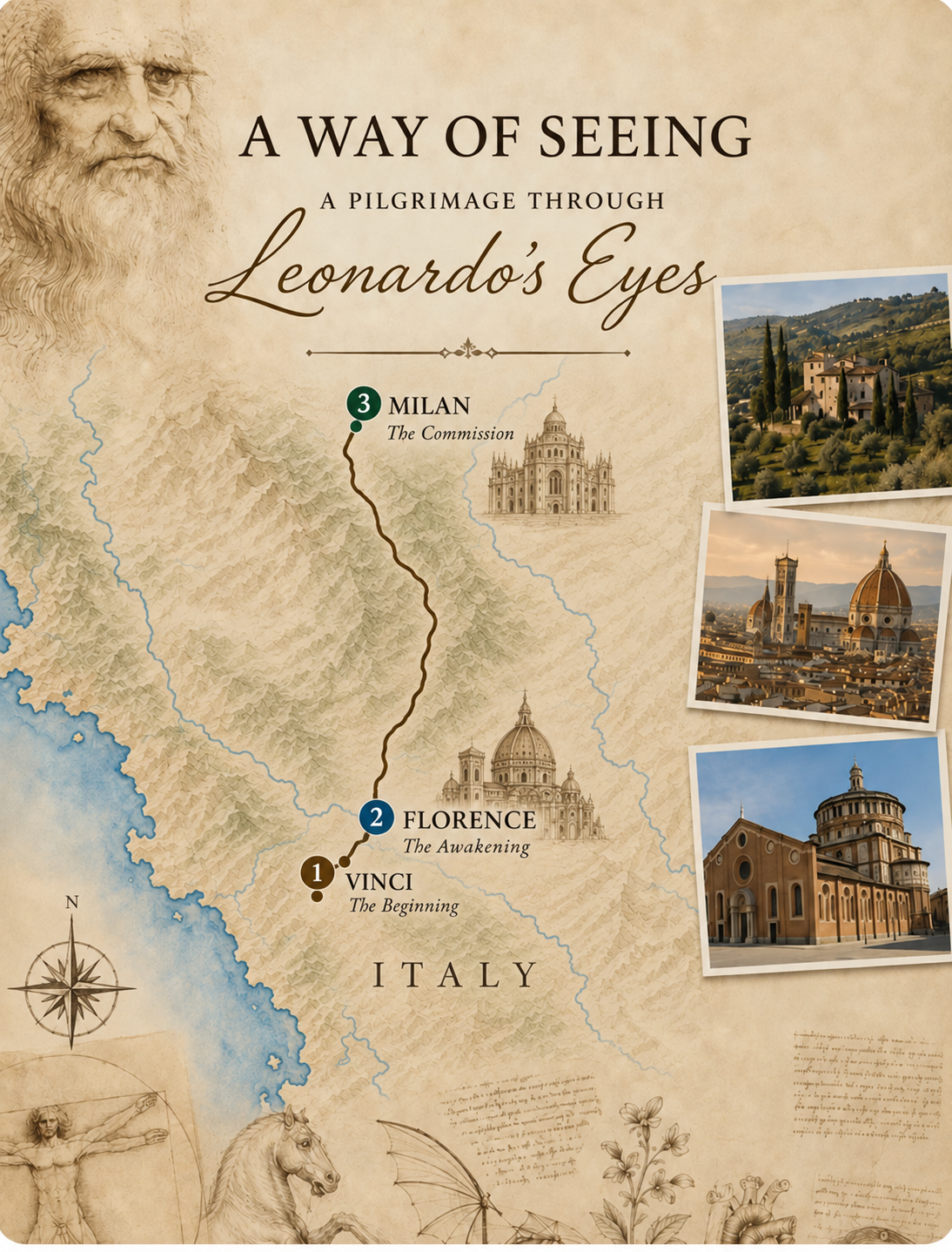
In Leonardo's Footsteps follows the path of his early life and helps us start changing our ways of seeing through exercises that can train your mind and your eyes to see in different ways. We start the journey in the landscape of Vinci, then we travel to Florence, where his artistic education took shape, and finally to Milan, where his curiosity for anatomy, engineering, and invention gave him the economical basis to manifest his curiosity.
Rather than simply visiting museums and historic sites, we will move through the places that shaped him, I will guide you through his world with a sensitive eye and open mind.
A Journey Through Three Worlds

Vinci
The Awakening of Curiosity
We begin in the Tuscan countryside where Leonardo spent his childhood. Here, among vineyards, olive groves, forests, and streams, we slow our pace and experience the landscape of Vinci, immersing ourselves in the nature that surrounded Leonardo and shaped his attentiveness.
Before Leonardo became the artist, inventor, and visionary we know today, he was a curious child observing the world around him. Nature became one of his earliest teachers. The movement of water, the flight of birds, the structure of plants, the play of light and shadow, and the patterns he discovered in the landscape would continue to appear throughout his art and notebooks.
I will introduce simple exercises here you can use in the rest of the journey, that will help your attention and mindset of the Ways of Seeing concept.

Florence
The Education
At sixteen, Leonardo entered Florence, one of the most vibrant cultural centers of the Renaissance. In Andrea del Verrocchio's workshop, he learned painting, sculpture, engineering, and architecture, surrounded by artists and craftsmen exploring new ways to represent the human body, nature, movement, light, and perspective.
Florence was also alive with philosophical conversations. Humanism, Neoplatonic thought, and Jewish mysticism were influencing artists and scholars alike. Ideas about beauty, proportion, symbolism, and the relationship between humanity and the divine shaped the creative atmosphere in which Leonardo matured.
Here, we explore the Florence Leonardo knew, walking its streets, entering its churches and museums, and encountering the art and architecture that surrounded him.
We begin to see how his education extended far beyond the workshop, into a city where art, philosophy, science, and spirituality were continually informing one another.

Milan
The Mature Leonardo
When Leonardo entered the court of Ludovico Sforza, his world changed dramatically. Milan offered stability, generous patronage, and the financial freedom to pursue projects in painting, engineering, architecture, music, and science.
Here, Leonardo was able to move beyond the traditional boundaries of the artist. He designed machines and military devices, studied anatomy, experimented with architecture, planned theatrical spectacles, investigated the movement of water, and continued filling his notebooks with observations and ideas. His curiosity moved freely from one discipline to another, each question leading him toward the next.
It was also in Milan that Leonardo created The Last Supper, one of the most recognized works of art in the world. We will experience the painting in the place for which it was created, allowing ourselves to encounter it not only as an image reproduced countless times, but as a work existing within its original architectural and spiritual setting.
Leonardo also envisioned and designed improvements to Milan's system of waterways, including ideas for canals, locks, and connections that would improve navigation through the city. The Navigli district offers us another way to consider Leonardo's fascination with water, engineering, movement, and the relationship between human ingenuity and the natural world.
Milan brings us into the mature Leonardo, where the artist, scientist, engineer, philosopher, and observer become increasingly difficult to separate. His work reveals a mind that did not divide the world into subjects, but continued looking for the connections between them.
Our journey ends here, in a modern city that continues to value art, design, innovation, and new ideas. After following Leonardo from the countryside of Vinci through the creative awakening of Florence, Milan brings us forward into the present.


Lodging


Agriturismo Hotel Monna Caterina
Where Leonardo's Story Began
Nestled among the vineyards and rolling hills of Tuscany, just outside the village of Vinci, Monna Caterina offers something extraordinary: the opportunity to stay on land intimately connected to Leonardo da Vinci's childhood.
Named in honor of Leonardo's mother, Caterina, the estate celebrates its connection to the place where, according to local history, the young Leonardo took his first steps. The surrounding landscape, with its vineyards, olive groves, and ancient agricultural traditions, is much the same countryside that inspired his lifelong fascination with nature.
Here, we will make our home for five nights, enjoying the comforts of a charming Tuscan wine resort, with its gardens, swimming pool, traditional hospitality, and locally produced wines. There will be time to wander, share meals, enjoy a glass of local wine, and experience the rhythms of the countryside before and after our explorations of Vinci and Florence.


The House of Stories
Where the Renaissance Meets the Present Day
After immersing ourselves in the landscapes, art, and extraordinary imagination of Leonardo da Vinci, we arrive in Milan, a city where centuries of history coexist with contemporary creativity, design, and innovation.
Our home for the final chapter of our journey is 21 House of Stories Navigli, a contemporary boutique hotel in Milan's vibrant Navigli district, celebrated for its historic canals, artistic atmosphere, lively cafés, and restaurants.
In contrast to the traditional Tuscan countryside where our pilgrimage began, this hotel embraces the spirit of modern Milan. Its thoughtfully designed rooms, creative gathering spaces, Italian bistro, and panoramic rooftop terraces overlooking the city offer comfort with a distinctly contemporary personality.
There is something wonderfully appropriate about ending our journey here. Leonardo was a man centuries ahead of his time, an artist, inventor, engineer, and visionary whose curiosity continues to influence how we understand and shape our world.
The Renaissance was never just a moment in history. It was a way of thinking, questioning, imagining, and creating. And that spirit is very much alive today.
Who Is This Journey For?
This journey is not designed to tell you what to see. It is designed to have you see exactly what your eyes see in the first place.
Through easy exercises that help you change your way of seeing, I will guide you through a world of art and help you explore and experience new ways of seeing. This is a very easy fun and mind opening way to anyone curious about exploring art and philosophy in new ways.
As with all Ways of Seeing experiences, historical knowledge is an add on the phenomenological experience rather than replacing it. We begin with direct perception before interpretation, allowing each place to speak before we speak.
This trip welcomes anyone who is drawn to:
- Art and Renaissance history
- Philosophy and symbolic thinking
- Jewish Mysticism and Kabbalah
- Personal reflection through attention
- Slow, meaningful cultural experiences
- The life of Leonardo da Vinci
No previous knowledge of Leonardo or art history is required - only curiosity.
Details and Information
Dates
- Arrival: April 21, 2027 in Vinci, Italy
- Departure: April 28, 2027 from Milan, Italy
Investment
...coming soon
Early Bird discount applies if the deposit is received before December 31, 2026
What's Included
- Seven nights accommodation and breakfast
- 4 dinners
- Daily Professionally Guided Facilitation
- Train to Milan
- Museum entrance fees
What's Not Included
- Airfare
- Lunches and 3 dinners
- Alcoholic beverages and soft drinks
- Optional activities or excursions
- Personal purchases
- Tips and gratuities
- Travel insurance
- Passport, visa, or entry-related expenses
- Expenses caused by delayed or canceled flights
Conditions
50% deposit is required to secure your reservation.
Final payment is due by January 15, 2027
We can not offer any refunds.
Payment may be made by:
- Bank transfer
- PayPal
- Visa/Mastercard
Any bank or currency-conversion fees are the responsibility of the participant.
We recommend travel insurance that covers:
- Trip cancellation and interruption
- Emergency medical care
- Medical evacuation to your home country
- Pandemic-related disruption
- Force majeure events
Travel Planning
You can fly into Florence Airport, Amerigo Vespucci International Airport (FLR), or Pisa International Airport (PSA), which is closer to Vinci, where our journey begins.
We will all meet on April 21 at the charming Agriturismo Hotel Monna Caterina, just outside Vinci. If you would like to arrive a day or two early and settle into Tuscany before we begin, you are welcome to contact the hotel directly at info@winemonnacaterina.it.
We will make Monna Caterina our home for five nights, allowing us to unpack, settle in, and explore without changing hotels. On April 24 and 25, our private minibus will take us into Florence, departing around 10:00 a.m. and returning around 5:00 p.m.
On April 26, we leave Tuscany and travel by comfortable high-speed train from Florence to Milan, a journey of about two hours. In Milan, we will stay in the lively Navigli district, known for its canals, restaurants, cafés, galleries, and evening life. Milan is wonderfully easy to explore by Metro, on foot, or even by bicycle.
Our journey together concludes on April 28, but your Italian adventure does not have to end there. You may choose to continue exploring Lombardy, the Italian lakes, the mountains, or another corner of Northern Italy.
We are happy to provide guidance as you coordinate your arrival, departure, and any additional travel in Italy.